Introduction
In
highly sensitive analytical chemistry, the integrity of your sample container
is just as critical as the calibration of your instrument. A common and costly
challenge faced by laboratories is the appearance of "ghost
peaks"-unexpected signals on a chromatogram that do not originate from the
sample itself. The root cause often lies in substandard sample vials or
degrading septa introducing extractables and leachables into the solvent. This
article provides a com. prehensive guide to solving this problem by
selecting the correct materials. By the end of this guide, you will understand
how switching to high-quality **2 ml HPLC Vials** made from Type I Borosilicate
Glass eliminates contamination, ensuring accurate, reproducible data for your
laboratory.
Quick Answer
To
prevent ghost peaks in chromatography, laboratories must use **2 ml HPLC
vials** manufactured from Type I Borosilicate Glass paired with chemically
inert PTFE/Silicone septa. This combination minimizes ionic leaching and sample
interaction. Sourcing these from a certified **HPLC Vials Manufacturer**
ensures reliable trace and ultra-trace (ppb-ppt) analytical results without
contamination.
Key Takeaways
Ghost peaks are primarily caused by
extractables and leachables from low-quality vials and septa.
Type I Borosilicate Glass: offers the highest chemical resistance across a broad
pH range (1.5 to 13), preventing ionic leaching.
Proper
septa selection (e.g., bonded PTFE/Silicone) prevents silicone degradation and
sample contamination.
*Vials
manufactured in ISO Class 7 EUGMP Grade C cleanrooms eliminate environmental
particulate contamination.
Strategic lab equipment procurement** should
prioritize certified, low-extractable vials for trace analysis.
Table of Contents
1. What Causes Ghost Peaks in Chromatography?
2.
The Crucial Role of Type I Borosilicate Glass
3.
Septa Selection for 2 ml HPLC Vials
4.
Standard vs. Certified Low-Extractable Vials (Comparison Table)
5.
Best Practices for Handling and Storage
6.
Buying Guide: Sourcing Chromatography Consumables
7.
Case Study: Eliminating Baseline Noise in Trace Analysis
8.
Frequently Asked Questions (FAQs)
9.
Conclusion and Actionable Recommendations
Main Content
What Causes Ghost Peaks in Chromatography?
Ghost
peaks are unexpected, erratic signals on a chromatogram caused by contaminants
leaching into the sample solvent from the vial or the septa.
In
simple terms, when the liquid sample reacts with cheap glass or punctures a
low-quality cap, microscopic chemicals dissolve into the liquid. The
chromatography instrument detects these chemicals, confusing them for the
actual sample being tested.
Technically,
these contaminants are known as extractables and leachables. When strong polar
solvents interact with active silanol groups (Si-OH) on poor-quality glass
surfaces, it alters the pH and distorts the Relative Standard Deviation (RSD)
and Retention Time (RT).
Practical Example:
A lab testing pharmaceutical formulations for impurities might see an extra
peak at the 4-minute mark. Instead of being a drug impurity, the peak is
actually silicone oil that bled from a non-bonded septa after needle puncture.
Expert Tip: Always run a "blank" sample (just the solvent in
the vial) before your analytical run to establish a baseline and identify if
your chromatography consumables are the source of ghost peaks.
Common Mistakes: Washing and reusing disposable vials. Micro-scratches from
washing expose active glass sites, drastically increasing the risk of ionic
leaching and sample adsorption.
Benefits of Solving This:
Ensures
data integrity and regulatory compliance.
Reduces
machine downtime and troubleshooting hours.
Prevents
costly batch re-testing.
#The Crucial Role of Type I Borosilicate Glass
To
prevent sample degradation, analytical vials must be manufactured from Type I
Borosilicate Glass (Class A).
This
specific material is engineered with a high silica content and an extremely low
alkali metal fraction. Because it is hydrolytically stable, it prevents basic
oxides like sodium and calcium from migrating into the analytical sample.
Technical Details: Type I Borosilicate glass provides exceptional chemical
resistance across an extreme pH range of 1.5 to 13. This guarantees that
whether you are using highly acidic or highly basic solvents, the container
wall will not degrade or interact with the analytes.
Industry Standards: A reputable **HPLC
Vials Manufacturer** will ensure their glass meets global pharmacopeia
standards, including USP <660> and <661>, EP 3.2.1, and ISO 3585.
Features:
*
Extremely low alkali content.
*
Inert to active silanol group interactions.
*
High thermal stability for elevated temperatures.
### Septa Selection for 2 ml HPLC Vials
Choosing
the right septa is just as important as the glass vial to stop ghost peaks.
The
septa is the rubber-like seal inside the cap. For optimal performance,
laboratories should use caps with bonded PTFE (Polytetrafluoroethylene) and
Silicone septa.
Explanation: The PTFE layer faces the sample, providing an inert chemical
barrier, while the silicone layer provides the flexibility needed for the
needle to pierce. When sourcing these **chromatography consumables**, look for
caps where the septa is molecularly bonded to the plastic. This prevents the
septa from slipping or being pushed into the vial by the autosampler needle, a
common cause of siloxane contamination.
Pros & Cons of PTFE/Silicone:
Pros: Highly inert, reseals well after multiple punctures, ideal for trace
analysis.
Cons: Can core if the autosampler needle is dull.
Standard
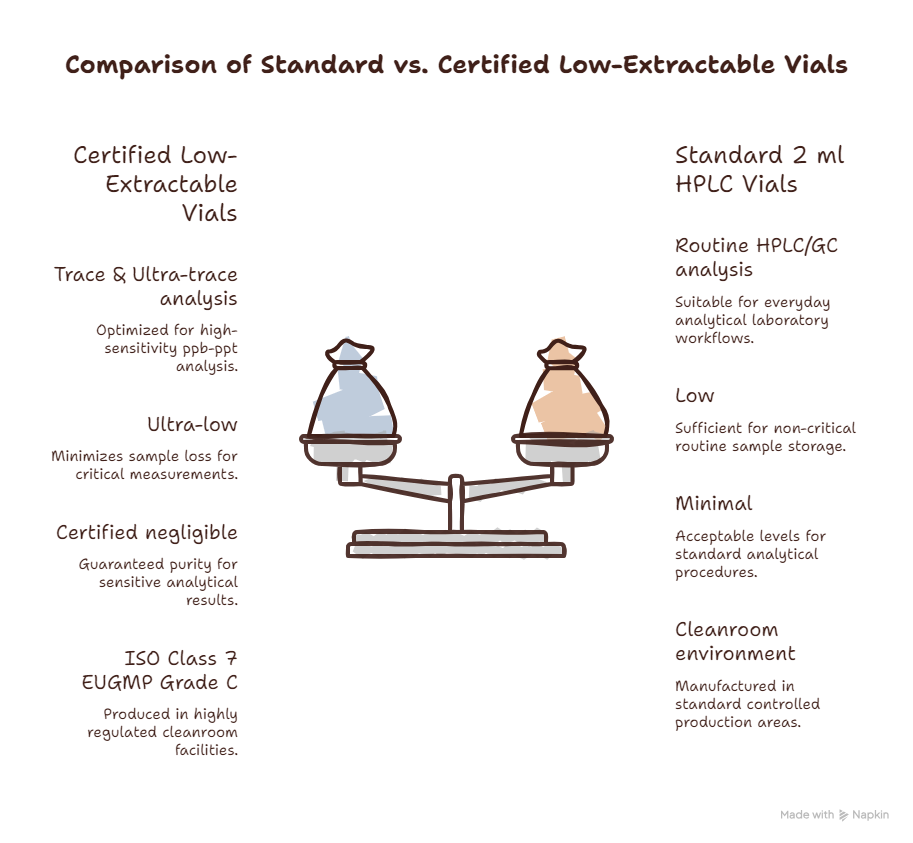
vs. Certified Low-Extractable Vials (Comparison Table)
|
Feature |
Standard 2 ml HPLC Vials (e.g., BSBCV02) |
Certified Low Extractable Vials (e.g.,
BSBCV02-33) |
|
Glass Type |
Type I
Borosilicate (Class A) |
Type I
Borosilicate (Class A) |
|
Best
Application |
Routine
HPLC/GC analysis |
Trace
& Ultra-trace (ppb-ppt) analysis |
|
Surface
Adsorption |
Low |
Ultra-low |
|
Extractables/Leachables |
Minimal |
Certified
negligible |
|
Manufacturing
Environment |
Cleanroom
environment |
ISO Class
7 EUGMP Grade C cleanrooms |
###
Best Practices for Handling and Storage
Even
the highest quality **2 ml HPLC Vials** can cause ghost peaks if handled
improperly.
Never
touch the PTFE septa or the rim of the vial with bare hands. Oils and salts
from human skin transfer easily and will show up on highly sensitive detectors
like Mass Spectrometers (MS).
Expert Tips:
*
Store vials in a dedicated, dust-free environment away from volatile organic
compounds.
*
Leave vials in their original shrink-wrapped packaging until immediately before
use to prevent environmental contamination.
*
Use designated vial trays (like the 50-position BSBVT02) to safely transport
samples across the lab without dropping or scratching them.
Buying Guide: Sourcing Chromatography Consumables
Effective lab equipment procurement requires looking beyond the price
per unit. The cost of a failed analytical batch due to ghost peaks far
outweighs the savings of buying cheap consumables.
When
evaluating an HPLC Vials Manufacturer, demand transparency regarding
their manufacturing and inspection processes. Ensure that products undergo
automated robotic inspections to verify dimensional accuracy and glass
integrity.
Furthermore,
procure consumables that are handled and packed within ISO Class 7 EUGMP Grade
C cleanrooms to guarantee surface consistency and product purity. Request a
Certificate of Analysis (COA) to ensure batch-to-batch reproducibility.
Case Study: Eliminating Baseline
Noise in Trace Analysis
A
Contract Research Organization (CRO) specializing in clinical formulations was
experiencing recurrent ghost peaks during ultra-trace (ppt level) impurity
testing. The noise was disrupting their Relative Standard Deviation (RSD)
limits.
After
auditing their lab equipment procurement process, they discovered their
generic vials were leaching sodium oxides into their high-pH mobile phase.
By
partnering with an Indian CMO, BSB Pharma Analytic, the lab switched to 2ml
Certified Glass Vials (Part Number: BSBCV02-33) paired with bonded 9mm blue
screw caps (Part Number: BSBUSWRBPS09). Because the vials were manufactured
from hydrolytic Type I Borosilicate glass in an ISO Class 7 cleanroom, the
ionic leaching stopped completely, and the baseline noise was eliminated,
restoring analytical integrity.
Frequently Asked Questions (FAQs)
Q:
What is the primary cause of ghost peaks in HPLC?**
A:
Ghost peaks are typically caused by extractables and leachables from
poor-quality glass vials or degraded septa contaminating the sample solvent.
Q:
Why is Type I Borosilicate Glass recommended?**
A:
**Type I Borosilicate Glass** (Class A) is highly hydrolytic, offering low
alkali content and high chemical resistance across a pH range of 1.5 to 13,
preventing sample contamination.
Q:
Can 2 ml HPLC vials be used for trace analysis?**
A:
Yes, certified low-extractable vials are manufactured with chemically inert
internal surfaces to minimize ghost peaks, making them ideal for ultra-trace
(ppb-ppt) analysis.
Q:
Are these vials compatible with Gas Chromatography (GC)?**
A:
Absolutely. High-quality borosilicate vials offer high thermal stability and no
deformation at elevated temperatures, making them perfect for GC and headspace
analysis.
Q:
What is the benefit of a bonded septa?**
A:
Bonded PTFE/Silicone septa are molecularly fused to the cap, which prevents the
septa from slipping into the vial during needle puncture, avoiding siloxane
contamination.
Q:
What cleanroom standards should an HPLC Vials Manufacturer follow?**
A:
Reputable manufacturers produce and inspect their vials inside ISO Class 7
EUGMP Grade C cleanrooms to ensure product purity and eliminate particulate
contamination.
Q:
What regulatory standards apply to chromatography vials?**
A:
Vials should comply with global pharmacopeia standards, including USP
<660> & <661>, EP 3.2.1, and ISO 3585 / ISO 8362.
Q:
Is it safe to wash and reuse HPLC vials?**
A:
No. Washing creates micro-scratches on the glass surface, exposing active
silanol groups which leads to sample adsorption and leaching.
Q:
What does a Certificate of Analysis (COA) prove?**
A:
A COA ensures full traceability and batch-to-batch reproducibility, proving the
vials passed strict automated robotic dimensional and purity inspections.
Q: Do BSB Pharma vials fit all major analytical instruments?
A:
Yes, standard 2 ml vials are designed to be universally compatible with major
autosamplers, including Waters, Agilent, Shimadzu, and Thermo systems.
Conclusion
with Actionable Recommendations
Ghost
peaks and baseline noise compromise data integrity and waste valuable
laboratory resources. The most effective way to prevent these issues is by
investing in high-quality **chromatography consumables**.
Actionable Recommendations:
1.
Upgrade your glass: Audit your inventory and ensure your **lab equipment
procurement** exclusively sources **2 ml HPLC vials** made from hydrolytic
**Type I Borosilicate Glass**.
2. Verify cleanroom standards: Only purchase from an **HPLC Vials
Manufacturer** that utilizes automated robotic inspections in ISO Class 7 EUGMP
Grade C cleanrooms.
3.
Switch to bonded caps: Prevent septa bleed by transitioning to
molecularly bonded PTFE/Silicone screw caps.
**ADDITIONAL OUTPUT**
**Internal Link Suggestions:**
* Link "PTFE/Silicone septa" to the Caps and Septa product page
(`/capssepta.html`).
* Link "vial trays" to the Fitting Accessories page referencing
part BSBVT02 (`/chromatography-Consumables.html`).
**External Authority References:**
* Link "USP <660> and <661>" to the official U.S.
Pharmacopeia guidelines on glass containers.
* Link "ISO 3585" to the International Organization for
Standardization page for borosilicate glass 3.3.
**Image Ideas with SEO Alt Text:**
* *Image 1:* Close-up macro shot of a 2 ml clear glass vial with a blue
screw cap inside an analytical instrument.
* *Alt Text:* 2 ml HPLC Vials made
of Type I Borosilicate Glass for trace analysis.
* *Image 2:* An infographic illustrating the cross-section of a bonded
PTFE/Silicone septa preventing needle push-through.
* *Alt Text:* Diagram showing
bonded PTFE silicone septa preventing ghost peaks in chromatography
consumables.
Recommended Schema:
Article Schema:** To establish the page as an authoritative informational
resource, defining the author (e.g., BSB Pharma Technical Team) to satisfy
E-E-A-T.
* **FAQPage Schema:** Apply to the 10 FAQs to ensure they are
machine-readable and highly extractable for AI Overviews and LLM query fan-out.
* **Product Schema:** Apply to specific product mentions like BSBCV02 and
BSBCV02-33, detailing material (borosilicate glass) and use cases.
* **Organization Schema:** For BSB Pharma Analytic Pvt. Ltd. to solidify
brand entity recognition across search engines.